Joby Aviation is conducting flight demonstrations between Manhattan and JFK
Integrating eVTOLs at Commercial Airports
Written By ,Airspace Engineer
PublishedApril 29 2026

Our Ongoing Collaboration with the FAA and NASA
Airport transfers represent one of the clearest near-term applications for electric vertical takeoff and landing aircraft. The demand profile is bidirectional, the time savings are significant, and the use case aligns with how ground transportation already functions in every major metropolitan area. I've spent ten years on this airspace integration problem—first at NASA, then at Uber Elevate, and now at Joby—and the question has never been whether eVTOL aircraft can operate at commercial airports. The question has been how to demonstrate it to the satisfaction of the FAA, airport authorities, and air traffic control professionals who will ultimately make it work.
With the announcement of the eVTOL Integration Pilot Program (eIPP) in March 2026 and Joby's participation across five state projects, including Florida, that proof-of-concept phase is now underway.
Precedent and Principles
High-tempo VFR VTOL operations in busy airspace have strong current and historical precedent. At Las Vegas Harry Reid International, a Class B airport and the fifth busiest airport in the world by aircraft movements, controllers regularly handle more than 100 helicopter operations in a single hour. During major events, that number exceeds 2,000 operations over a single weekend without impacting runway throughput. At the Downtown Manhattan Heliport (JRB) in uncontrolled Class G airspace in New York City, operations at tempos greater than 60 arrivals or departures per hour occur safely on a regular basis—managed entirely through pilot self-coordination on a common traffic advisory frequency.
Joby's 2025 acquisition of Blade's passenger business gives us direct operational exposure to these environments. Blade’s contracted operators flew more than 50,000 passengers in 2024 from a network of 12 urban terminals, including facilities at JFK, Newark, and multiple Manhattan locations. That experience, managing high-frequency vertical lift operations in some of the most complex airspace in the country, further informs our integration planning. The procedures, customer flows, and coordination protocols that Blade has refined over years of air mobility service provide a practical foundation as we prepare to transition passengers to electric aircraft.
The operational principles that enable high-tempo VTOL operations are well understood: dedicated VTOL control positions in the tower, pre-defined routes with coded altitude profiles, streamlined voice procedures that reduce per-aircraft communication time, air traffic control (ATC) standard operating procedures that balance workload across positions, and automatic correlation of callsigns to radar targets. When these elements are present, the constraints on throughput become controller workload and voice frequency congestion, both of which can be managed through procedure design.
Observations from multi-year simulation efforts with NASA and the FAA confirm that these same principles apply to eVTOL operations. In controller-in-the-loop testing adapted from high-tempo helicopter environments, operational tempos as high as one arrival and one departure per minute were achievable at airports with widely spaced runways, with roughly half that rate at airports requiring runway crossings to reach the operating area.
The Orlando Work
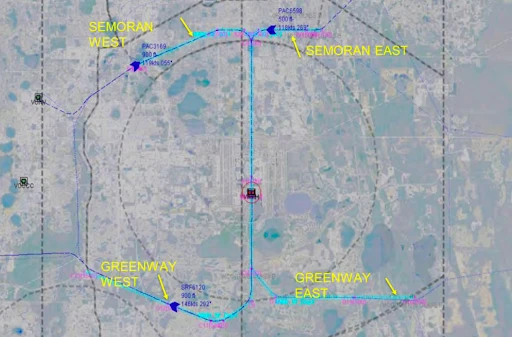
Florida was among the first states to move aggressively on advanced air mobility infrastructure, and the Greater Orlando Aviation Authority (GOAA) initiated its examination of eVTOL operations at Orlando International Airport (MCO) with a tabletop exercise in November 2024. That exercise reviewed proposed vertiport sites and preliminary route structures for both north- and south-flow configurations. The routes and procedures evaluated in subsequent human-in-the-loop simulation at the FAA's William J. Hughes Technical Center emerged directly from those discussions with GOAA, MCO and ORL tower controllers, and NATCA representatives.
The simulation tested three vertiport locations: a central site at a proposed multi-modal transportation hub near Terminal C, a proposed east site that is approximately one mile from the nearest runway, and a west ramp location near existing FBOs. Each location was evaluated individually and in combination, with eVTOL traffic layered onto legacy traffic scenarios based on historical PDARS data. Researchers deliberately increased arrival and departure rates of eVTOLs to stress-test controller workload.
The FAA report findings identified which configurations and routes worked and which required modification. Controllers confirmed that a dedicated Class B controller position would be essential for managing eVTOL traffic, particularly when multiple vertiports operate simultaneously. Certain departure routes needed adjustment to provide more time to climb to altitude before interacting with legacy traffic. Arrival routes were refined to reduce approach angles and minimize the coordination burden between controllers. These are exactly the kinds of operational details that simulation is designed to identify before aircraft start flying.
The simulation work at MCO now informs Florida's participation in the eIPP, announced on March 9, 2026. The state's proposal encompasses cargo, passenger, automation, and medical response operations across multiple phases, with significant public and private investment committed. The procedures and route structures developed through the HITL process provide the operational foundation for what comes next.
Evolving Separation Procedures
In March 2026, the FAA issued GENOT N JO 7110.801, establishing interim separation procedures for helicopters and powered-lift aircraft crossing arrival and departure paths in Class B, Class C, and TRSA airspace. The notice requires that visual separation cease in these situations, pending further evaluation.
Joby has always designed its airspace integration procedures to ensure radar separation requirements are met between airline traffic and powered-lift aircraft. A foundational principle for this industry is that eVTOL operations must not disrupt conventional jet traffic or trigger collision avoidance systems. Our work with NASA and the FAA—through the Advanced Air Mobility (AAM) National Campaign and testing at the FAA Technical Center—has reinforced this approach from the outset.
Joby aircraft are equipped with ADS-B In and Out, enhancing situational awareness and compatibility with the ATC environment. The eIPP will provide Joby and the broader industry an opportunity to demonstrate procedural mitigations that ensure safety and enable the responsible growth of AAM operations in the National Airspace System.
The eIPP and What Follows
The eVTOL Integration Pilot Program creates the regulatory pathway to translate validated concepts into actual operations. Operations under the program have already started in New York, and are expected to begin in the other states by the summer of 2026. The preparatory work, years of simulation, procedure development, and coordination with air traffic professionals positions these initial services to proceed on a foundation of tested concepts rather than untested assumptions.
The first operations will be modest in scale, which is appropriate. Real-world experience will identify considerations that simulation cannot fully capture, and the responsible approach is to build confidence incrementally. The objective is to demonstrate that eVTOL aircraft can operate safely and efficiently alongside legacy traffic at commercial airports, generating the operational data needed to inform the regulatory frameworks that will enable broader deployment.
The infrastructure exists. The procedures have been tested. The aircraft are in the final stages of certification. What remains is execution.
Eric Mueller serves as Airspace Engineer at Joby Aviation, where he develops concepts, procedures, methodologies, and technologies to enable the safe operation of aerial ridesharing aircraft alongside traditional airspace users. Prior to joining Joby, he led the design, development, and deployment of airspace services at Uber Elevate and spent nearly two decades as an aerospace engineer at NASA, where he contributed to research on urban air mobility, aircraft collision avoidance, air traffic control automation, and the integration of novel aircraft types into the national airspace system. Mueller holds a PhD in Aerospace Engineering from Stanford University, with dissertation research focused on machine learning techniques for collision avoidance of multi-rotor UAS, and a BS in Aerospace Engineering from Princeton University.


